Common questions
A few of the things we get asked most.
A few of the things families ask us most. If yours isn't here, please send us a note. We read every message and try to write back within a couple of days.
Joining the waitlist
What's the difference between the application and the waitlist?
The application tells us about you, your home, and the puppy you're hoping for. It costs nothing and commits you to nothing. Once we've read it and approved you, a $300 reservation fee puts you on the waitlist. The list runs in the order those reservations arrive, and within each litter you're offered the puppies that match the preferences you gave us. That $300 applies toward your puppy's price. If you're not sure where to start, start with the application.
How long is the waitlist?
Most families wait somewhere between 2 and 6 months from joining the waitlist to when their puppy comes home. Color and sex preferences move that number more than anything else. If your heart is set on a cream or a dapple, plan on waiting longer, sometimes considerably longer, because those are the colors most families hold out for. Flexibility is the single biggest thing that shortens a wait. We'd rather tell you honestly where you sit than make you feel like things are moving faster than they are.
What does it cost?
We give you our current pet placement price by email and in your portal once your application is approved, before you decide whether to reserve anything. We keep the number off the website rather than leave an out-of-date one sitting here: food, veterinary care, and travel all get more expensive over time and our pricing follows, so you should have the figure from us rather than from a page written months ago. What goes into it is imported lines, Embark testing on both parents, OFA evaluations where they matter, and eight weeks of veterinary care and raising in our home. The $300 reservation and the $200 deposit both apply toward the price. Full AKC registration carries an additional fee on top of that price. We set that fee and it isn't negotiated, but it isn't the same for every puppy either: it's higher on the lines we are working to protect. If you're interested in showing or breeding, note it on your application and we will go over the fee and terms like co-ownership and health-testing expectations with you.
What's due, and when?
There are three points. The $300 reservation, once your application is approved, which puts you on the list. Another $200 when you accept a specific puppy, which turns your reservation into a $500 deposit on that puppy and comes alongside the contract. Then the balance during the week before go-home, which needs to clear before pickup. Nothing is due in between.
What happens to our money if we change our mind?
Before you've accepted a puppy: if we don't have one for you inside the time frame we estimated and you'd rather not keep waiting, the whole $300 comes back. If the timing stops working for any other reason, $200 comes back and the remaining $100 covers the cost of having held your place. Once you've accepted a specific puppy, the $500 stays with that puppy. The one exception is ours. If something happens on our end and we can't place that puppy with you, you choose between everything you've paid coming back to you or moving to another puppy.
How are puppies matched to families?
Your position on the list is set by the date your reservation arrived, with two exceptions we would rather say plainly than have you discover later: we pick first from our own litters, and an approved breeding partner taking a puppy with full AKC registration may be placed ahead in the order. Within a litter, you're only offered the puppies that match the preferences you gave us, and if none of them do, you keep your position for the next litter while the puppies from that litter go to families below you on the list. We prioritize temperament at the parent-breeding level, in the dogs we choose to pair and why, so by the time a litter is on the ground every puppy is starting from a good place. When your turn comes, we email you the puppies available to you with photos and our notes on how each one is showing up, so you can choose on color, sex, structure, and temperament. You make the final call, with our guidance.
Health, testing and care
How do you handle health testing?
Every dog in our program runs the full Embark genetic panel (IVDD, PRA, NCL, DM, and 250+ markers) before any breeding decision. That's how we keep pairings safe and avoid producing puppies with preventable genetic conditions. On the dogs we're building lines around, we add OFA evaluations for eyes, patellas, and cardiac. The Health Testing page has the per-dog details with links back to each lab.
What about back problems?
It is the right thing to ask about this breed. Every dog in our program is tested for the IVDD (CDDY) variant as part of the Embark panel. Nearly every dachshund carries it, since it's part of what gives the breed its short legs and long back, so it's breed-typical rather than a red flag on its own. Rather than a pairing decision, we manage it in each dog's daily life: keeping them lean, controlled exercise, and a harness instead of a neck collar. The Health Testing page lists what each of our dogs has been tested for.
What vaccinations will our puppy have had?
Your puppy comes home having had their first shots, with a health certificate from our veterinarian that you can take to your own. We suggest booking that first appointment for around two weeks after go-home, which is when the next round falls due, and your veterinarian will set the schedule from there.
What is our puppy eating?
Purina ONE Healthy Puppy. We leave a bowl out so the litter can graze and every puppy gets enough, and once yours is home we'd suggest moving to set meals. We send a small bag along so you can keep them on the same food at first. Changing food the same week they change households tends to upset a young stomach, so if you want to switch, switch later and slowly.
How big will our puppy get?
Under the breed standard, miniature is defined as eleven pounds and under at twelve months of age and older, so size is judged at a year rather than at eight weeks. Ours generally finish between nine and eleven pounds. The best guide for any individual puppy is what their parents weigh, and we're glad to tell you.
More on the breed standardWhen should we spay or neuter?
Not before twelve months, and there's a fair case for waiting longer than that. The reason is specific to this breed rather than general puppy advice: a large owner survey of dachshunds found that dogs neutered before a year had more disc disease, and that females neutered at any age had more of it than females left intact. A separate study built on veterinary hospital records found no such effect, so this isn't settled either way. Keeping your dachshund lean matters at least as much as the timing does. Talk it through with your veterinarian, knowing there's no reason to rush it.
Coming home
How old are puppies when they come home?
Eight weeks. That's the earliest New Hampshire allows a puppy to be placed, and it's also when we think they're ready: eating well on their own, steady on their feet, and past the point where leaving their mother would set them back. If you're planning travel, count eight weeks from the litter's birth date.
Can we visit before bringing a puppy home?
You'll meet your puppy on pickup day. We don't host visits at our home beforehand: young puppies are vulnerable to what visitors carry in on hands and shoes, and their mother settles better without new faces around. Once you have accepted a puppy, you'll get photos, videos, and milestone updates in a private album, so you'll watch your puppy grow up even though the first time you hold them is at go-home.
Do you ship puppies?
No, and we are not able to hand a puppy to a flight nanny or a pet transport service either. Sending a puppy that way calls for USDA licensing we don't hold. Your puppy goes home with you. Most families drive to us, and if you would rather fly, we can meet you at the airport so your puppy travels in the cabin with you. An airport meet carries an additional cost, the same as any meeting away from our home, so reach out in advance to coordinate and get pricing. Once you have a go-home date we will work around your travel so the timing fits.
What's included with a puppy?
Health certificate, age-appropriate vaccinations, deworming, a written health guarantee covering genetic and congenital conditions through your puppy's first year, and lifetime breeder support, plus a take-home kit with food and a blanket and toy carrying mom's scent. Microchip and AKC registration paperwork are available on request at an additional cost.
Do we need AKC registration papers?
Not for a pet placement. Registration matters if you intend to breed or show, and it changes nothing about your puppy's pedigree or who their parents are. We stopped including the paperwork by default because most pet families never sent it in. If you would like it, tell us and we'll arrange it for an additional cost.
Life with a miniature dachshund
Will a mini dachshund be happy in an apartment, or home alone while we work?
Yes to the apartment. They're small, they don't need much room, and a couple of good walks a day suits them well. They travel nicely in a car too, especially from somebody's lap. Ours are content on their own during the day and aren't destructive about it. Dachshunds are devoted to their people, and we don't have any in our home with separation anxiety. They do well with other dogs, more so once they know them, and then they'll play.
Are they good with children?
Ours grow up in the middle of a busy household, so children, noise, and being handled are all ordinary to them. Because this is a long-backed breed, the thing worth teaching children early is how to lift a puppy with their back supported, and to discourage jumping down from furniture and beds.
Long-haired or smooth, and when does the coat come in?
We breed long-haired miniature dachshunds. The breed comes in three coats, long-haired, smooth, and wire-haired, and a long-haired puppy can look deceptively short-coated early on. The feathering on the ears, chest, legs, and tail fills in gradually, and the coat isn't fully developed until around two years of age.
More on the breed standardStraight from the families who asked first
Most of these questions came up in a real conversation before the puppy came home. Here's how it looked from the other side.
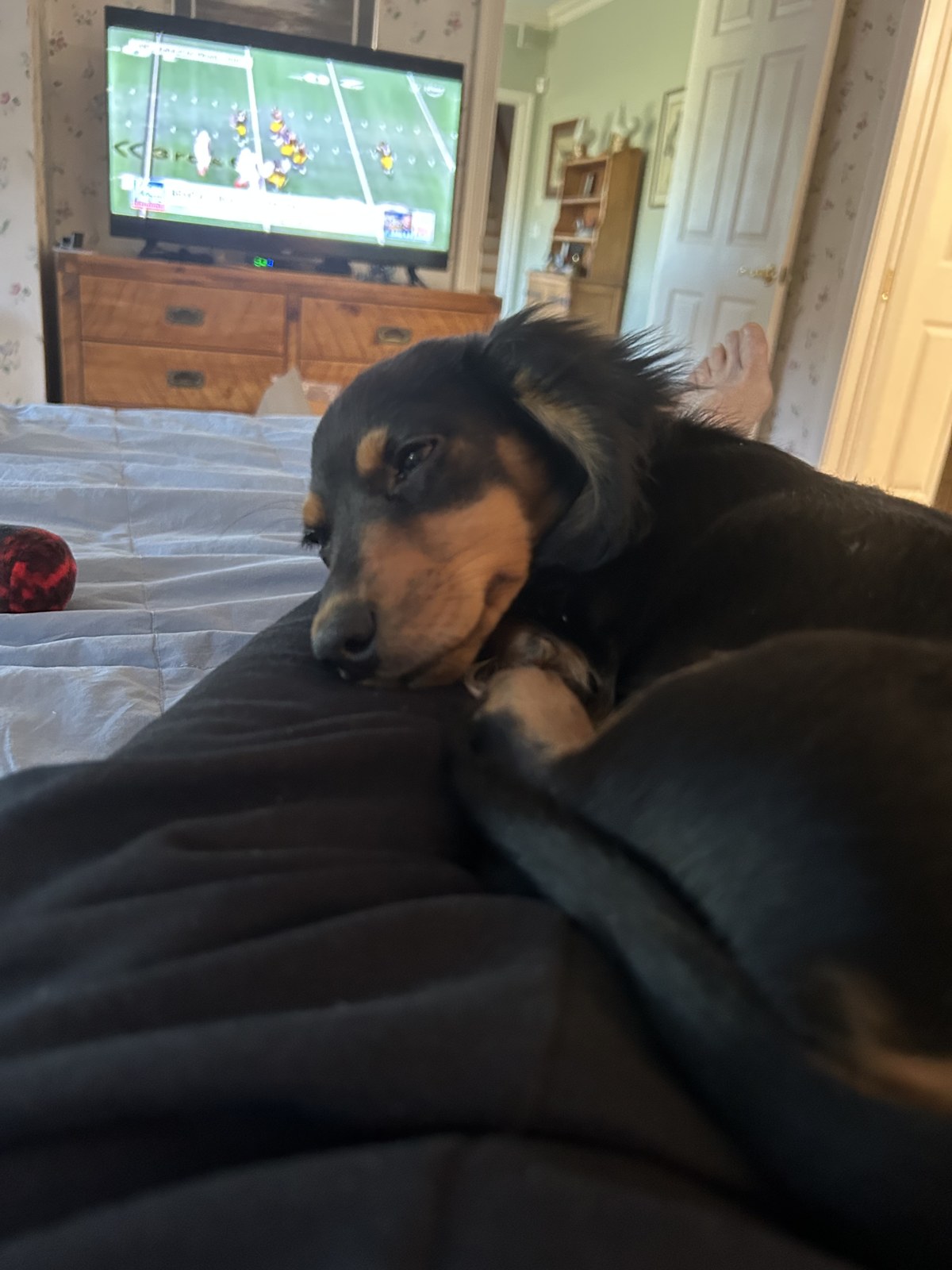
“Oscar continues to be an absolute delight! Over the years, our family has mostly had Labs and Corgis so it has been so fun getting to know a new breed. Thank you for such a great experience with Oscar.”
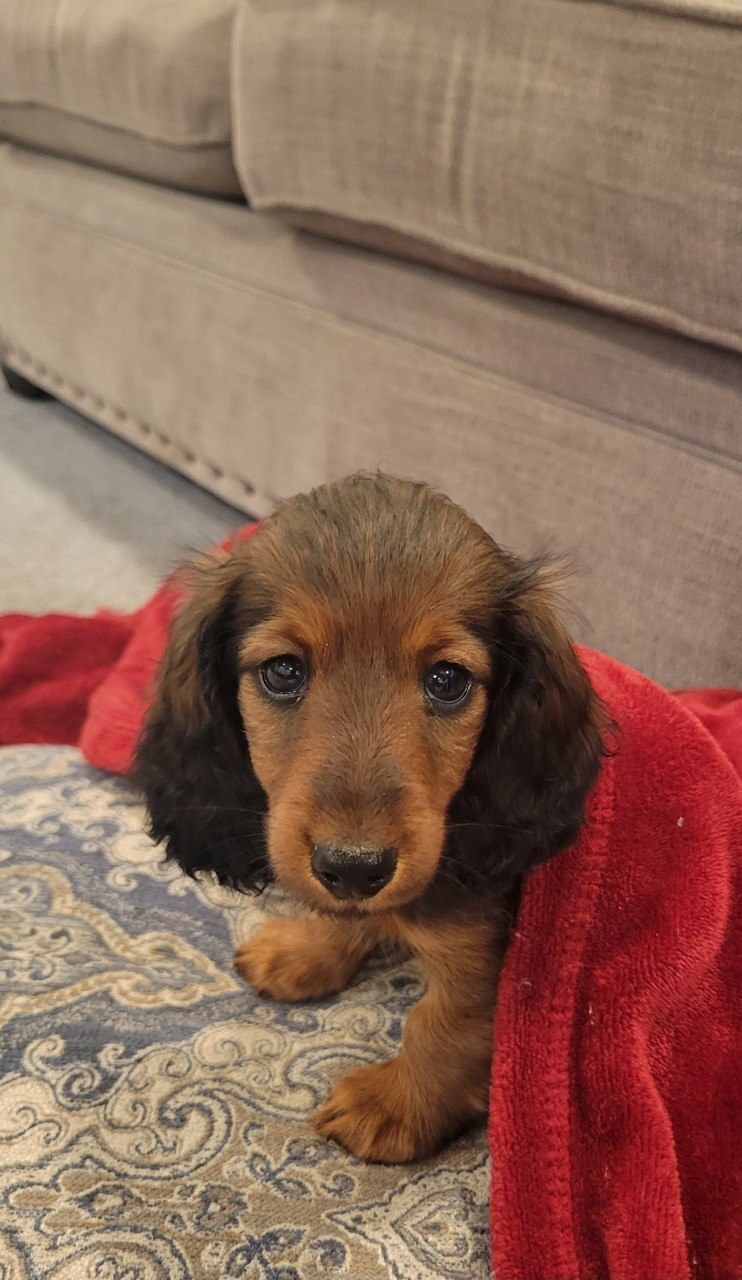
“we are absolutely loving 'Theodore', definitely far more calm and laid back than our short haired dachshunds, hes been doing great so far. my son almost cant be separated from him :)”