Every recognized breed has a written description of what it is supposed to be: proportion, movement, coat, temperament, and the faults that count against it. That document is the breed standard. The AKC publishes it, but it is written and revised by the Dachshund Club of America, the breed's parent club, which is the group of long-time breeders and judges who hold the definition of the breed.
The standard is not a health document and it is not a promise about any one puppy. It is the yardstick, and it is the reason a handful of terms you will see advertised elsewhere have no official meaning at all.
What "miniature" actually means
This is the part most families come looking for, and the answer surprises people: miniature is not a separate breed, and it is not even a separate variety. There is one dachshund standard. Miniatures are a class division within it, defined by a single line:
11 pounds and under at 12 months of age and older.
That is the whole rule. Every other word of the standard, the proportion, the front, the temperament, applies identically to a miniature and to a standard dachshund. A miniature is not a scaled-down dachshund with different requirements. It is a dachshund that finished under eleven pounds at a year old.
Two things follow from that. The first is that size is measured at twelve months, not at eight weeks, so no honest breeder can guarantee an adult weight on a puppy. The best guide is what the parents weigh, which is why we tell you. The second is that a dog who finishes at twelve pounds is not defective. It is simply a dachshund that sits outside the miniature division.
The three coats
The standard recognizes three coat varieties, and they are judged as separate divisions in the ring:
- Smooth, the short dense coat most people picture first.
- Long-haired, with feathering on the ears, chest, legs, and tail.
- Wire-haired, with a harsh outer coat, a beard, and bushy eyebrows.
We breed long-haired miniature dachshunds. A long-haired puppy often looks deceptively short-coated early on; the feathering fills in gradually and the coat is not fully developed until around two years old.
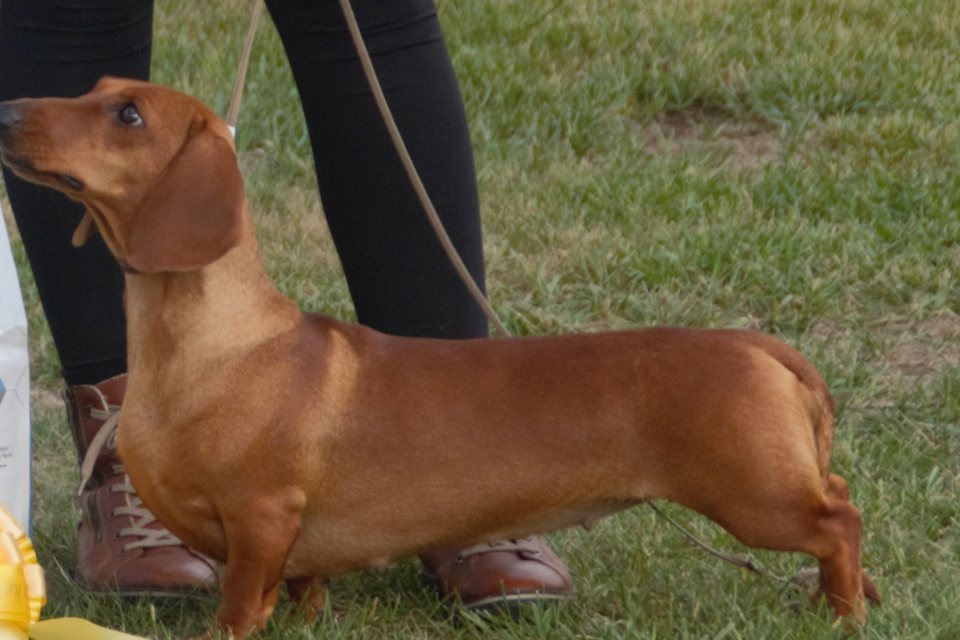
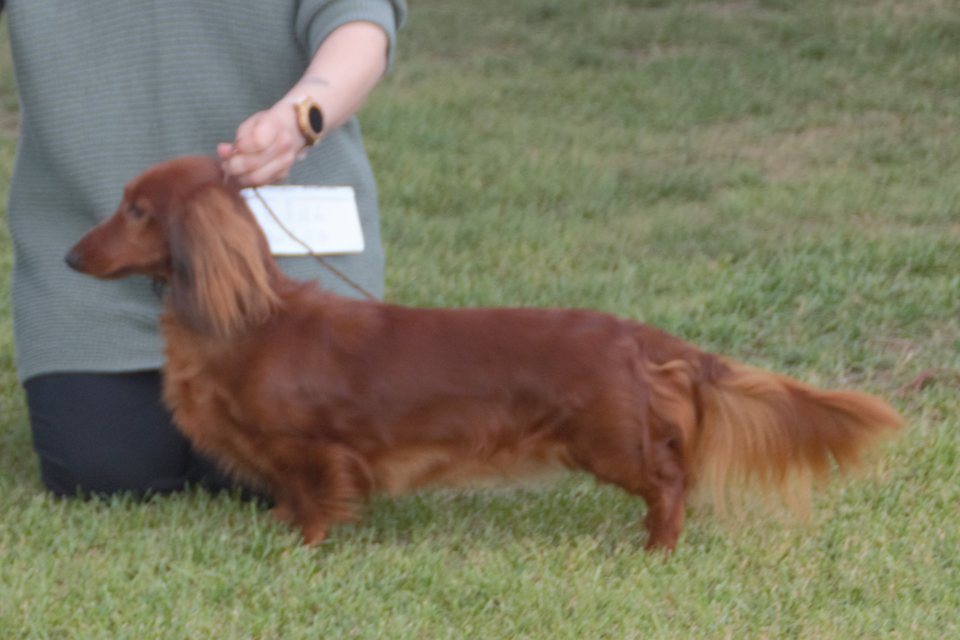
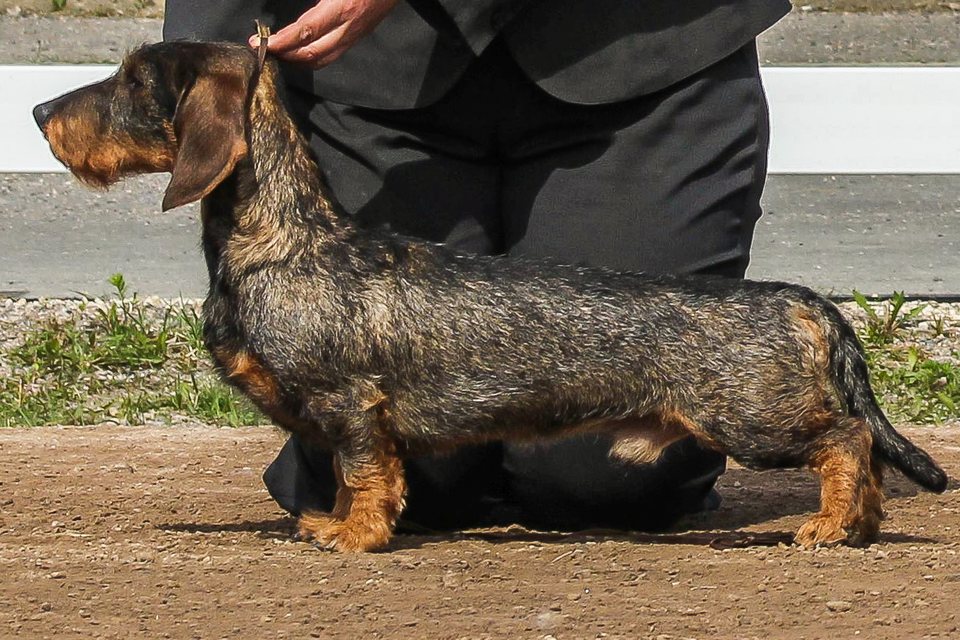
Smooth, long-haired, and wire-haired, each stacked in profile. Coat is independent of size, so the same three varieties appear in miniatures. Photos by Canarian (smooth and long-haired) and Janne Seppänen (wire-haired) via Wikimedia Commons, CC BY-SA 4.0. Cropped and resized by us; these versions are offered under the same license.
What the standard describes
Read in full it is shorter than you would expect, and most of it is about structure. The opening lines set the whole frame: low to ground, short-legged, long in body, and carrying itself with its head up and a confident expression. It then works through the head, the front assembly, the body, the hindquarters, and the gait, with the front getting the most attention because it is the hardest part of the breed to build correctly.
It also describes temperament, which is worth reading if you are choosing a breed rather than a puppy. The standard asks for a dog that is friendly, alert, and courageous, and it is explicit that shyness is a serious fault.
Terms that are not in the standard
A few size words circulate in advertising and in casual conversation. None of them appear in the standard, and none are recognized by the AKC or by the Dachshund Club of America:
- Teacup, micro, and toy are marketing terms. There is no size division below miniature. A dog sold under one of these names is either an ordinary miniature described in inflated language, or it was bred deliberately small, which is not something the standard or the breed's health record supports.
- Tweenie is informal shorthand breeders use among themselves for a dog that finishes between the miniature and standard divisions, roughly twelve to sixteen pounds. It is a useful word in conversation and it is not a recognized size.
- King and giant are not standard terms either. The standard division simply has no upper weight written into it.
If you would like the one-line version of any term used across our site, including the color and health-testing vocabulary, see the dachshund glossary.
Read it yourself
We would rather point you at the standard than summarize it, so here are the sources in the order we would read them.
- The official AKC breed standard (PDF, four pages), approved November 2017 and effective January 2018. The same text sits behind "View Full Breed Standard" on the AKC's Dachshund page.
- The Dachshund Club of America's breed standard page, the same text from the club that writes it, with a printable version available as a PDF.
- The Illustrated Standard (PDF), which is the one we would hand you first. It puts drawings beside the written clauses, and the sections on proportion and on the dachshund front make far more sense with a picture next to them.
For the health side of the same question, what the parent club and the Orthopedic Foundation for Animals recommend that breeding dogs be screened for, see our health testing page, which links straight through to the requirements themselves.